
- With a real order and real goods, a Hong Kong company can sign with the overseas buyer and receive payment
- The Hong Kong company buys the goods outright and resells them — the money is trade payment, not a remittance service
- Hong Kong taxes only Hong Kong-sourced profits: 8.25% on a corporation's first HK$2 million, 16.5% above that
- Offshore profits are not exempt by default — you must claim and prove them
- Overseas income of a Chinese tax resident still has to be declared in China
- “Buying export documents” has been under formal tax scrutiny since STA Announcement No. 17 of 2025 — stay away
- Can a Hong Kong company export for you if you have no export licence?
- How does the overseas payment reach the Chinese factory?
- How do you export used lathes from China to Southeast Asia? A deal we just closed
- Is “buying export documents” still an option?
- How much tax does a Hong Kong company pay? Are offshore profits exempt?
- Can Hong Kong profits be moved to an overseas account? Do you declare them in China?
- How do you tell whether a Hong Kong trade agent is reliable?
1. Can a Hong Kong company export for you if you have no export licence?
Yes — as long as it is a real agency and a real trade: a qualified exporter in China declares the goods truthfully, the Hong Kong company signs with the overseas buyer and receives payment, and the contract, invoice, goods and money all match up.
In practice there are two compliant routes:
| Route | How it works | Who it suits |
|---|---|---|
| Entrusted export agency | A Chinese trading company signs an export agency agreement with the factory and exports, collects and claims rebates under its own licence | Factories without export rights that just want to sell |
| Hong Kong back-to-back trade | The Hong Kong company buys from the Chinese factory and resells in its own name to the overseas buyer; the factory exports to the Hong Kong company | Sales agents and traders who found the overseas buyer and want a Hong Kong entity to contract and collect |
Both routes share one rule: every contract has a real party, and every customs declaration matches real goods and real payment. If any link is “borrowed”, the whole chain fails.
2. How does the overseas payment reach the Chinese factory?
The compliant way is for the Hong Kong company to buy the goods outright: it buys from the Chinese factory and pays for them, then sells to the overseas buyer and is paid. Two contracts, two invoices, one flow of goods — every payment is a trade payment, not money collected and passed on for someone else.
This decides whether the chain is compliant. A Hong Kong company that simply receives money for others and forwards it on instructions is running a remittance service, which in Hong Kong requires a Money Service Operator licence from the Customs and Excise Department. Buying outright is different: the Hong Kong company is a party to the contracts, carries the commercial risk on the goods and the payment, and the money follows the goods:
- Overseas buyer → Hong Kong company: sales contract and commercial invoice; the buyer pays the Hong Kong company
- Hong Kong company → Chinese factory: purchase contract; the Hong Kong company pays as agreed
- Chinese factory (or its appointed trading company): declares the export truthfully and receives the foreign-exchange proceeds
- Hong Kong company: earns the margin and files Hong Kong profits tax
3. How do you export used lathes from China to Southeast Asia? A deal we just closed
With used machine tools, the hard part is rarely finding a buyer. It is export qualification, truthful declaration, cross-border payment and rust-proof packing for heavy equipment. We recently bought a batch of production-line lathes outright through our Hong Kong company and sold them on to Southeast Asia for a veteran equipment buyer.
Who the client is: a veteran buyer in the equipment trade. His former company sold Japanese and Korean machinery to Chinese factories. Now retired and working freelance, he knows exactly which factory runs which machines and where the consumables come from.
Where the opportunity came from: in recent years many orders have followed factories out of China. The orders left; the imported production lines stayed behind, idle, and the factories want to sell. New plants in Vietnam and elsewhere in Southeast Asia, and in Japan and Korea, need exactly this equipment. Same machines, same contacts — only the direction has reversed.
What he was missing: he could close buyers and find stock, but had no export licence as an individual; the factories wanted proper payment into their accounts; and the overseas buyers wanted to pay a credible company.
What we did:
- Our Hong Kong company signed purchase contracts with the factories, bought the equipment outright, and signed sales contracts with the overseas buyers
- We arranged a qualified exporter to clear customs, with description, HS code and used condition declared truthfully
- The factories received genuine trade payments and the buyers paid the Hong Kong company, so both money flows match the goods
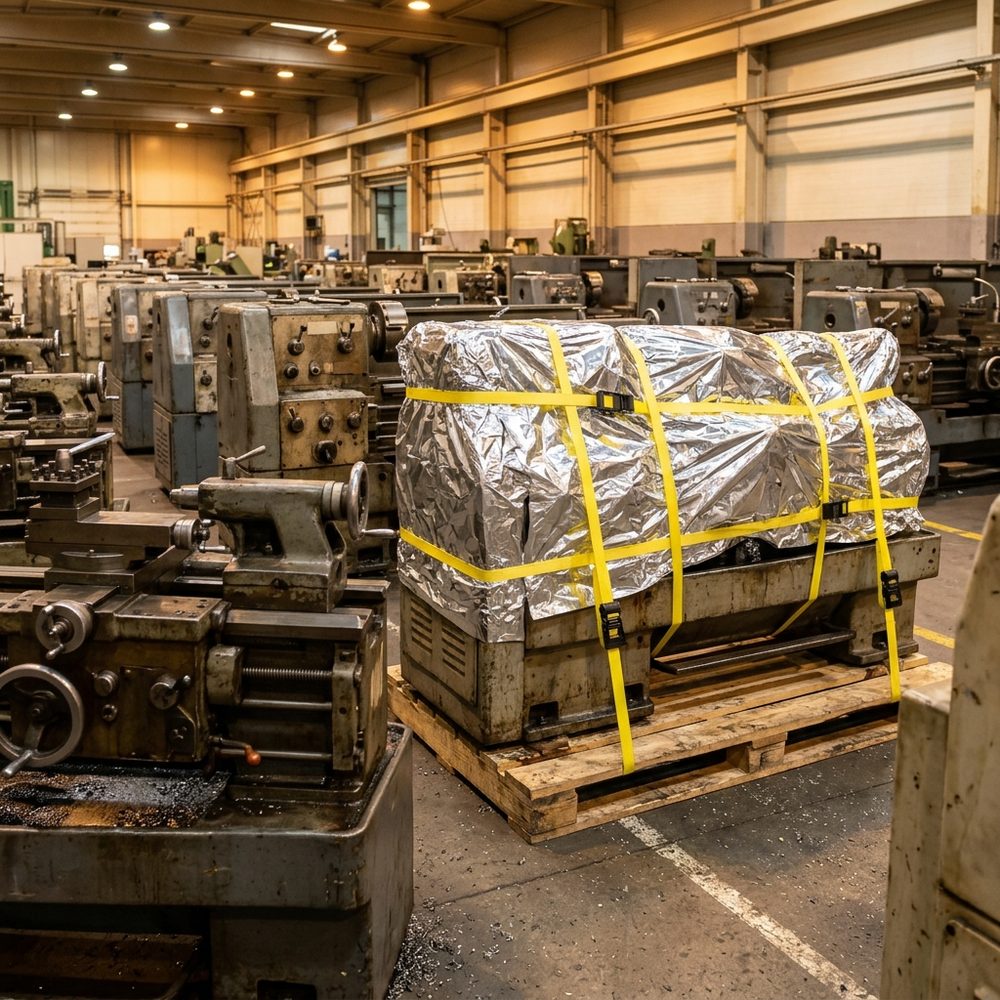
The trap we hit — packing: lathes are large and go by sea, so they need vacuum rust-proof packing, or they arrive as scrap. We spoke to several packing firms before finding one whose workmanship and sense of responsibility we could trust.
The lesson we took away: expertise lowers risk, but you do not have to do everything yourself. Choosing the right partners is itself how you avoid being burned — without enough industry track record, it is easy to hand a critical step to someone you should not rely on.
4. Is “buying export documents” still an option?
We advise against it. Buying export documents means an unlicensed business or individual buys someone else's export paperwork to ship goods. China's State Taxation Administration brought it under formal regulation with Announcement No. 17 in July 2025, and Shenzhen tax authorities published nine enforcement cases at once.
Under China's Regulations on the Administration of Import and Export of Goods and the Customs Law, exporting with forged or purchased customs documents is a serious violation, punishable by fines and, in serious cases, criminal liability. The buyer also gives up the export rebate, the paperwork sits in someone else's name, and if the seller is involved in false invoicing or rebate fraud, the buyer can be dragged in.
5. How much tax does a Hong Kong company pay? Are offshore profits exempt?
Hong Kong taxes on a territorial basis, so only Hong Kong-sourced profits are charged profits tax: 8.25% on a corporation's first HK$2 million of assessable profits and 16.5% above that. Offshore profits can be claimed as exempt, but only with solid documentary evidence.
- Two-tier rates once per group: among connected companies in a group, only one can use the lower rate on the first HK$2 million
- Offshore claims are reviewed: trading profits are generally sourced where the purchase and sale contracts are effected, but the Inland Revenue Department reviews claims closely, including staff, operations and fund flows
- Exempt does not mean no filing: the Hong Kong company still needs an annual audit and profits tax return
6. Can Hong Kong profits be moved to an overseas account? Do you declare them in China?
They can be distributed lawfully, but there must be a basis — a shareholder dividend, or commission or service fees under a contract — and if the recipient is a Chinese tax resident, that overseas income must still be declared in China.
Hong Kong participates in the Common Reporting Standard (CRS) and exchanges financial account information of mainland tax residents with mainland tax authorities. Since 2025, tax bureaus in Shanghai, Zhejiang and elsewhere have been prompting individuals to self-check and declare overseas income. Money held in Hong Kong or moved elsewhere does not become invisible.
Our position is simple: we help clients make the trade real, keep the paperwork complete, and pay tax where it is due. We do not help anyone hide income. What is worth paying for is a trade structure that stands up to banks, customs and tax authorities on both sides — not a “tax-free” slogan.
7. How do you tell whether a Hong Kong trade agent is reliable?
Check four things: is it a real party to the contracts, does it ask for full identity and trade documents, does it have a real Hong Kong entity and business substance, and does it promise “no tax” or “no need to declare”? Yes to the first three and no to the last — only then is it worth talking.
- Takes money, signs nothing, looks at no documents — most likely pass-through payments, with licensing and money-laundering risk
- Opens with “zero tax on profits” or “China can't see it” — walk away
- Explains the route first, including what it cannot do — that is a long-term partner
Quick self-check: how many can you answer?
| Question | Can you answer it now? |
|---|---|
| Is your overseas buyer real and willing to sign a formal contract? | No → don't look for an agent yet |
| Can the Chinese factory issue invoices that match the customs declaration? | No → the document chain will break |
| What entry documents does the destination need? Any age limit on used equipment? | No → goods may be stuck at port |
| Who ultimately owns the profit, and on what basis is it paid out? | Clear → we can discuss structure |
| If the recipient is a Chinese tax resident, how will the overseas income be declared? | Clear → this route can last |
You close the deal — we walk the rest of the way with you
Forever Gain HK Holding Ltd has long handled China import and export trade for clients, mainly on the New Zealand corridor; this deal applied the same capability to equipment trade in Southeast Asia. We buy the goods outright in our Hong Kong company's name and sell them to your overseas buyer — no pass-through payments, no sale of documents.
To be clear: every deal is reviewed case by case. We need to see a real buyer, real goods and full identity information before we start, and we do not take on non-compliant business. Please also consult your own accountant on tax.
When you get in touch, please tell us the product category, destination, buyer's country and expected order value range.
This note covers exports from China to anywhere in the world, contracted and collected through a Hong Kong entity. Forever Gain HK Holding works through entities in Hong Kong, Xiamen and New Zealand; our two New Zealand corridors have their own sites.
Our import & export trade agent service →Sources: Hong Kong Inland Revenue Ordinance (two-tier profits tax and territorial source principle); Anti-Money Laundering and Counter-Terrorist Financing Ordinance (Cap. 615) licensing of Money Service Operators; China State Taxation Administration Announcement No. 17 of 2025 and Shenzhen published enforcement cases; public notices by mainland tax authorities on declaring overseas income. The latest official requirements prevail.
FAQ
Can a Hong Kong company export from China for me if I have no export licence?
Yes, but a qualified exporter in China must still declare the goods truthfully, while the Hong Kong company signs with the overseas buyer and receives payment, with contract, invoice, goods and money all matching.
What is the difference between a Hong Kong trade agent and a payment collector?
A compliant Hong Kong trade agent buys the goods outright and resells them, so it is a party to the contracts and the money is trade payment; simply receiving money for others and forwarding it is a remittance service, which in Hong Kong requires a Money Service Operator licence.
Can used machine tools be exported from China to Southeast Asia?
Yes. A qualified exporter must declare the description and used condition truthfully, money must follow the goods, and the destination's rules on importing used machinery must be checked first; heavy equipment going by sea also needs vacuum rust-proof packing.
Is buying export documents illegal in China?
Exporting with forged or purchased customs documents is illegal, and STA Announcement No. 17 of 2025 brought the practice under formal regulation, with penalties ranging from fines to criminal liability.
What is the Hong Kong profits tax rate?
8.25% on a corporation's first HK$2 million of assessable profits and 16.5% above that; only one company in a group can use the two-tier rates. Offshore profits must be claimed with the Inland Revenue Department, backed by documentary evidence.
Will China know if Hong Kong profits are moved overseas?
Hong Kong participates in CRS and exchanges financial account information of mainland tax residents with mainland tax authorities; overseas income of a Chinese tax resident must be declared in China.
Have you handled China import and export before?
Yes. Forever Gain HK Holding has long handled China import and export trade for clients, mainly on the New Zealand corridor; the used-lathe export to Southeast Asia in this article applied the same capability to a new market.