
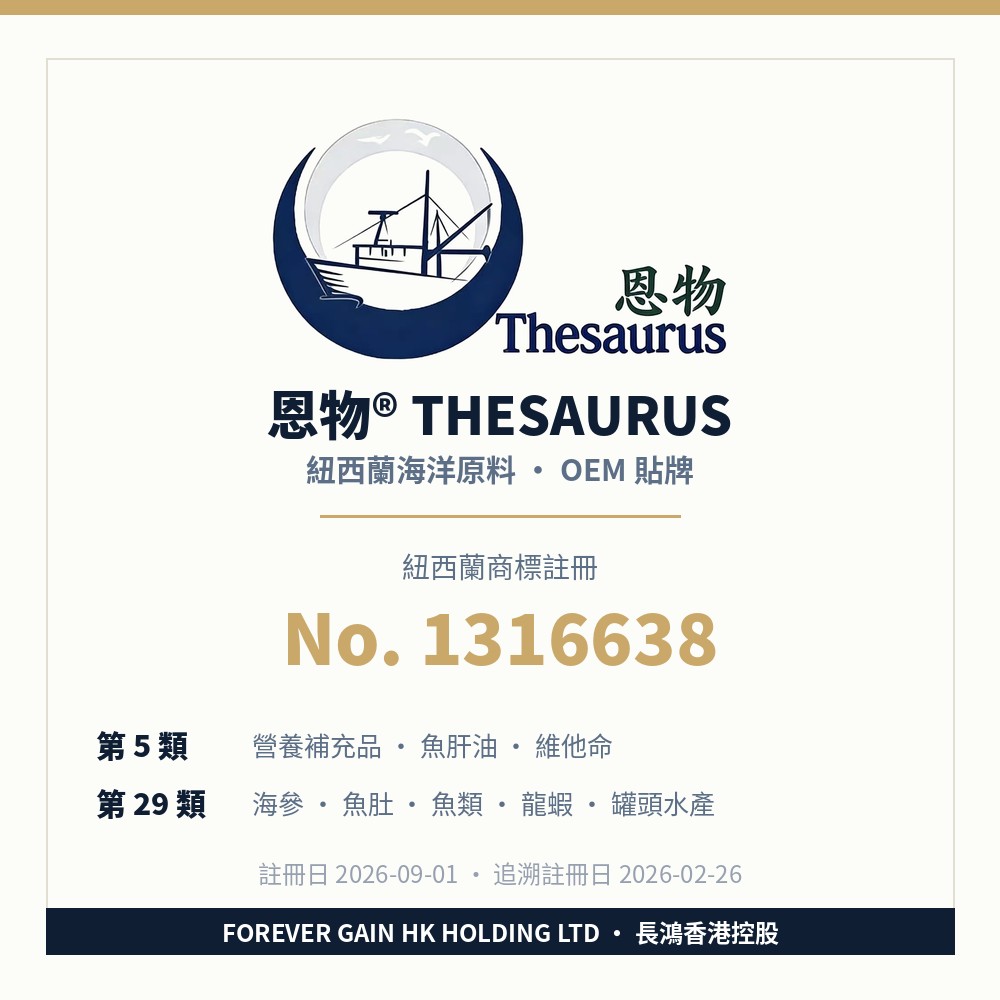
- NZ trade mark registration No. 1316638 (publicly searchable at IPONZ)
- Class 5: fish oil, vitamins, nutritional supplements, special dietary foods
- Class 29: sea cucumber, fish maw, fish, lobster, canned seafood
- New Zealand – Hong Kong – China, one point of contact
- Export to China needs separate overseas manufacturer registration (Decree 280)
- MOQ and sampling time assessed per category
1. Notice: New Zealand trade mark registration 1316638 is in force
Under the New Zealand Trade Marks Act 2002, the company’s trade mark was entered on the New Zealand register on 1 September 2026, with a deemed registration date of 26 February 2026. Details:
| Item | Detail |
|---|---|
| Registration No. | 1316638 |
| Mark | 恩物 / Thesaurus (combined word and device mark) |
| Owner | FOREVER GAIN HK HOLDING LIMITED, Workshop 1, G/F, Block B, Hi-Tech Industrial Centre, 491–501 Castle Peak Road, Tsuen Wan, Hong Kong |
| Entered on register | 1 September 2026 |
| Deemed registration date | 26 February 2026 |
| Issued by | Intellectual Property Office of New Zealand (IPONZ), signed by Commissioner of Trade Marks Ross van der Schyff |
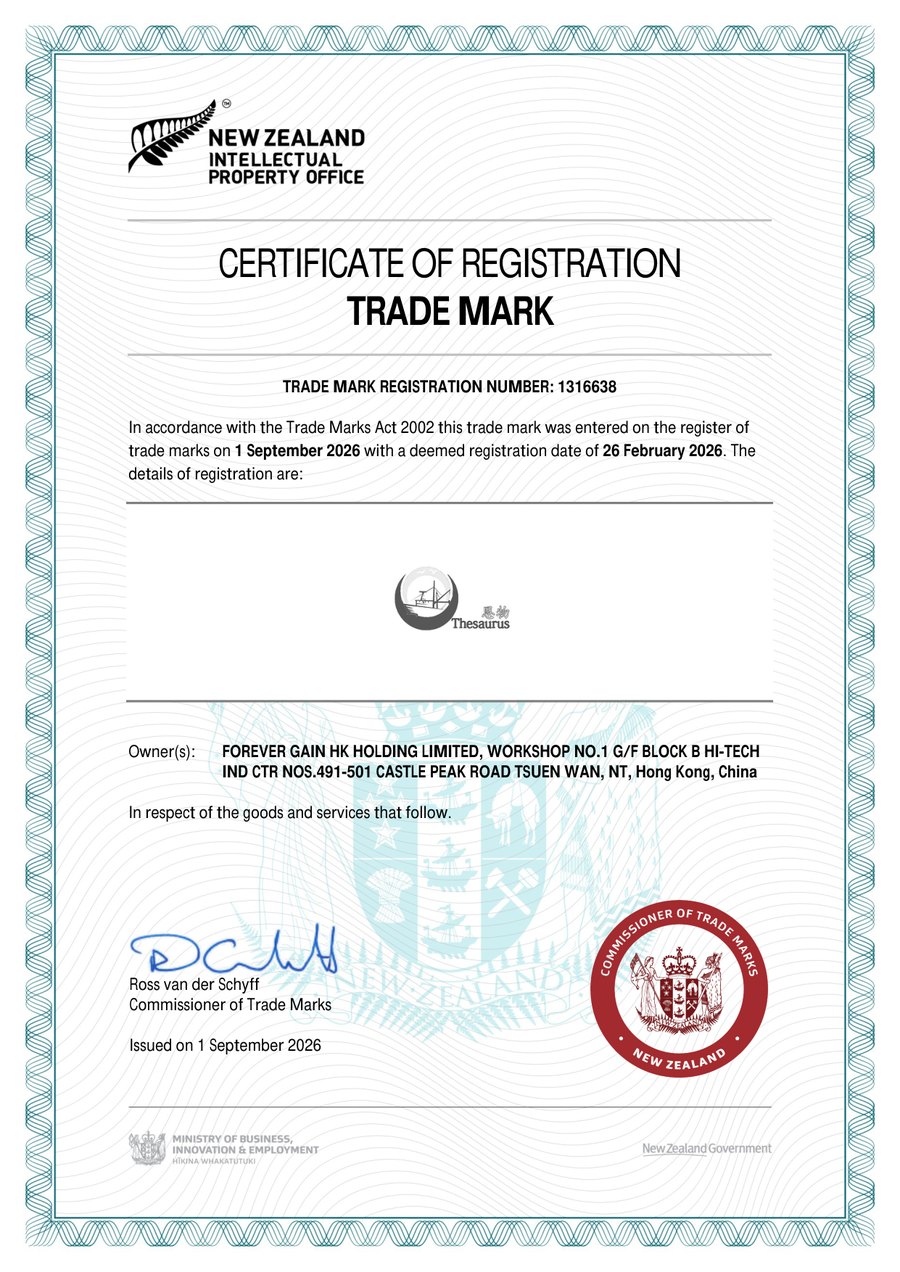
Certificate of registration issued by IPONZ. The number can be checked on the IPONZ trade mark search.
2. Two classes that cover the core of OEM
A trade mark’s value is not whether it is registered, but which classes it is registered in. That matters in cross-border health-product OEM: plenty of brands trade in New Zealand for two or three years before discovering their name is only registered in Class 5, so the moment they launch food-form products such as sea cucumber or fish maw they have no protection. Register only Class 29, and you get stuck the moment you make a capsule or powder.
In practice: deep-sea fish oil softgels, marine collagen powder, green-lipped mussel powder, vitamin and mineral formulas, foods for special dietary uses.
In practice: dried sea cucumber, whole and sliced fish maw, frozen and canned seafood, dried-goods gift boxes.
In other words, from a capsule to a whole fish maw, one brand can go the full distance — no switching brands halfway, no worrying that someone registers the second class first. For brands planning long term in New Zealand, this is the cheapest move available: fixing a squatted trade mark usually costs dozens of times the original filing fee.
3. The real hurdle is at the China end: Decree 280 in force from 1 June 2026
Whether New Zealand ingredients are good is not the hardest question. What has kept many small brands out over the past two years is China Customs’ registration requirement for overseas food manufacturers.
Four practical points of Decree 280
| Point | What it means in practice |
|---|---|
| 17 recommendation categories | Meat products, bird’s nest, bee products, dairy, aquatic products and others need recommendation from the exporting country’s competent authority; health foods and foods for special dietary uses are also on the official recommendation list |
| Two registration routes | Authority recommendation vs self-application. Self-applied registrations must be valid at the moment of import declaration — no renewing after the fact |
| No automatic renewal | Meat products, bird’s nest products and others must be renewed actively — forget, and supply stops |
| Declaration fields | Import declarations must correctly state the registration number and end use; customs will not accept them otherwise |
How it works on the New Zealand side
Because aquatic products and health foods are recommendation categories, the Ministry for Primary Industries (MPI) acts as competent authority in New Zealand. The usual process:
2. A third-party verifier carries out a document review and on-site audit
3. The manufacturer applies to MPI for recommendation
4. The registration is submitted through the CIFER system via the competent-authority route
5. Once the registration number is issued, only products made within the valid registration period can be declared for import into China
The route is workable — but for a first-timer, every step can stall. Document versions, audit timing, matching the registration number to the customs declaration: get any of these out of line and you find out when the goods reach port, which is too late.
4. What we have in place: New Zealand, Hong Kong and China
The FG Group’s structure is not for show. This chain crosses three jurisdictions, and each leg needs an entity that is actually on the ground.
| Node | Entity and resources |
|---|---|
| New Zealand | FG NZ Trade & Logistics Ltd (NZBN 9429053403940) — local licensed entity, marine-ingredient sourcing, Free Sale Certificate applications, export documentation |
| Hong Kong | Forever Gain HK Holding Ltd — holding company and owner of this trade mark; also a Hong Kong import-export trader handling mainland coordination, warehousing and logistics scheduling, and documentation |
| China | Xiamen filing, our own logistics capacity, and sales capability on cross-border channels such as Douyin — goods can get in, and can sell |
5. How an OEM project actually runs
2. Ingredients and formulation — confirm New Zealand sources, specifications, seasonal scheduling
3. Sampling — small trial batch, sensory and lab checks, packaging design
4. Compliance route — category classification, overseas manufacturer registration route, Chinese label pre-check
5. Production and export — NZ export documents, Free Sale Certificate, sea or air freight
6. Landing in China — customs clearance, registration-number and end-use declaration, warehousing, channel connection
Who this suits
Frankly, this chain is not for everyone. It suits brand owners who already have a clear channel (even one steady Douyin account or a group of offline distributors), are willing to follow the compliance process, and treat New Zealand origin as a long-term brand asset rather than a one-off gimmick. It does not suit those who want tiny trial batches with immediate delivery, or who hope to skip registration and bring in volume through personal-goods channels — after Decree 280 the risk of the latter only goes up.
Want to talk OEM? Start with your category and channel
Our New Zealand marine product lines, specifications and partnership models are on NZGOCH.COM. If you are heading the other way — a Chinese supplier going to New Zealand — use CHGONZ.COM. Warehousing and logistics in both directions are coordinated through Hong Kong.
NZGOCH.COM · NZ marine ingredients for China → CHGONZ.COM · Chinese suppliers to NZThis article covers New Zealand marine-ingredient OEM and private label, deployed year-round for Chinese consumers. NZGOCH.COM, driven by Forever Gain HK Holding, is the product and partnership window for that route.
NZGOCH.COM · NZ marine ingredients for China →6. Official sources to check
Every rule cited here can be verified. We recommend you do:
Chinese regulation — GACC Announcement No. 27 of 2026, gov.cn (Chinese)
New Zealand authority — MPI guidance on registering food businesses with China, mpi.govt.nz
Frequently asked questions
What goods does NZ trade mark registration 1316638 (Thesaurus®) cover?
Two classes. Class 5: fish liver oil; tonics (medicines); vitamin preparations; vitamin supplement patches; pharmaceutical preparations for human use; dietetic food, beverages and substances adapted for medical use; mineral dietary supplements; nutritional supplements. Class 29: meat; sea cucumbers (not live); fish (not live); fish maw; lobsters (not live); canned fish products; fruit-based snacks; processed laver; rapeseed oil for food; vegetable-based snacks; processed nuts. The owner is Forever Gain HK Holding Limited; entered on the register on 1 September 2026 with a deemed registration date of 26 February 2026.
Does a registered trade mark mean products can be exported straight to China?
No. The trade mark secures lawful use of the brand in New Zealand and protects it against squatting; it is a brand asset. Entering China separately requires overseas manufacturer registration under GACC Decree 280, meeting the market-access conditions for the product category, compliant Chinese labelling, and import declaration with inspection and quarantine. The two are independent, but the trade mark comes first — without it, filings, e-commerce listings and brand protection all run into trouble later.
How does GACC Decree 280 differ from the old Decree 248?
The Administrative Provisions on the Registration of Overseas Manufacturers of Imported Food (GACC Decree No. 280) were published on 14 October 2025 and took effect on 1 June 2026, replacing Decree 248. Key changes: a defined list of 17 food categories that require recommendation by the exporting country's competent authority; two separate routes, authority recommendation and self-application, with self-applied registrations required to be valid at the time of import declaration; meat products, edible bird's nest products and others placed on a no-automatic-renewal list; and mandatory, correctly completed registration-number and end-use fields on import declarations, without which customs will not accept the declaration.
Which registration route do New Zealand seafood and health foods follow?
Aquatic products are in the category that requires competent-authority recommendation, and health foods and foods for special dietary uses are also on the official recommendation list. In New Zealand the competent authority is the Ministry for Primary Industries (MPI). The usual process is manufacturer self-assessment, third-party verification (document review and on-site audit), an application to MPI for recommendation, then submission through the CIFER system via the competent-authority route. Only products made during a valid registration period can be declared for import into China.
For OEM, can I use your Thesaurus® brand or must I use my own?
Either. If you already have your own trade mark and positioning, we supply ingredients, formulation, manufacturing and the export chain, and the finished goods carry your brand. If you want a faster start with a brand already registered in New Zealand, Thesaurus® can be used within the scope of a licence. Which suits you depends on your sales channels and long-term plans, and is agreed case by case.
How are minimum order quantity and sampling lead time worked out?
They depend on category, dosage form and packaging, and vary widely — the minimum economic batch for softgels, powders, whole dried goods and canned seafood is completely different, and the seasonality of New Zealand raw materials also affects scheduling. So we do not publish a standard figure; we assess each item and then issue a formal quote and timetable. Tell us your target category, expected annual volume and target channel and we will arrange an assessment.
What role does the Hong Kong company play in this chain?
Forever Gain HK Holding Ltd has two roles. First, as the holding company it owns the New Zealand company FG NZ Trade & Logistics Ltd and holds NZ trade mark registration 1316638. Second, as a Hong Kong import-export trader it is the hub for mainland coordination, warehousing and logistics scheduling, and documentation — Chinese suppliers going to New Zealand use CHGONZ.COM, New Zealand marine ingredients going to China use NZGOCH.COM, and goods and paperwork in both directions are coordinated through Hong Kong.
Final word
A certificate of registration will not clear a shipment on its own. But it shows one thing: at the New Zealand end we operate under our own name, through our own entity — not borrowed, not resold. For a brand owner putting hundreds of thousands or millions in stock value on a new supply chain, a structure you can look up and a person you can hold to account matter more than any slogan.
If you are evaluating a New Zealand marine-ingredient OEM programme, tell us your category, expected volume and target channel, and we will reply with a workable route and timetable — including telling you straight if a route is not workable yet.